A Worldwide HF Propagation Dashboard: Predicted vs Observed, for Any QTH
Building on the UK HF Predictor
Last autumn I built a small experiment called the UK HF Predictor: a web dashboard that tried to answer one practical question, which bands are actually open from my station right now. It grew into something I used most days, and a few of you were kind enough to try it and send feedback. Since then I have rebuilt the whole thing from the ground up, and it now lives at a new home: https://hfprop.g4eid-km8h.net.
This post explains why I started again, what the new dashboard does, and how it works under the hood. The old UK site now redirects here, so any bookmarks you had will land in the right place.
Why rebuild it?
The original tool was firmly UK-centric. The maths assumed a station in these islands, and a lot of the logic was wired to that assumption. That was fine as an experiment, but it put a ceiling on what the tool could become.
I also wanted to be honest about something I had let drift in the first version. Prediction and observation had started to blend together into a single number, and a single number hides exactly the disagreements that are most interesting. When the model says a band should be dead and the band is plainly alive, that gap is the story, not noise to be averaged away.
So the rebuild had two firm rules from day one. First, it should work for any QTH in the world, driven by your locator rather than a hard-coded location. Second, the forecast and the measurement should always be shown as two separate numbers, never merged.
What it does
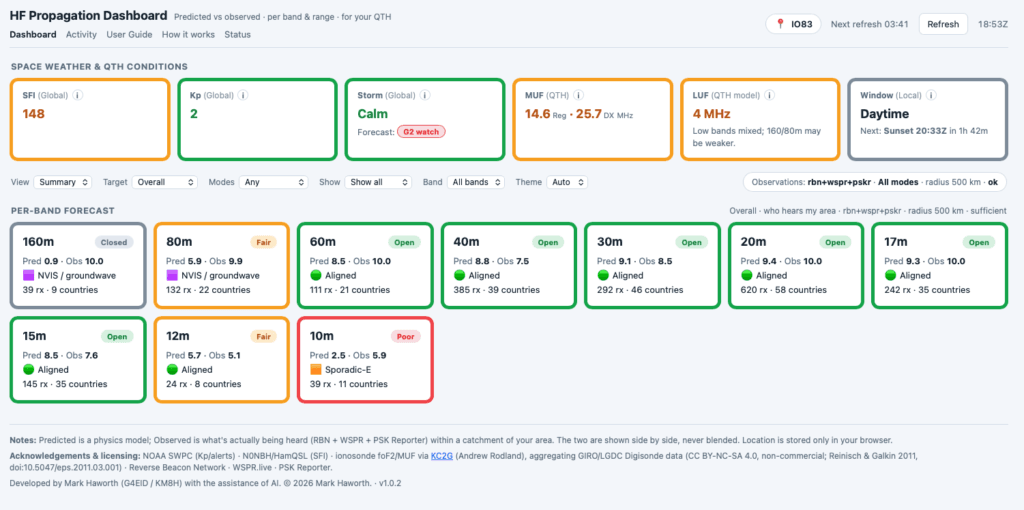
At its heart the dashboard shows, for each HF band, two scores side by side:
- Predicted: what the physics says the band should be doing, given the current ionosphere and solar conditions.
- Observed: what stations on the air are actually being heard right now, over what distances, by receivers near your location.
Both are on a simple 0 to 10 scale, and both are broken down by distance: Local, Regional, Continental and DX. A band can be wide open for short hops and shut for DX, and the dashboard shows that rather than collapsing it into one verdict.
Around the band table sits a row of condition tiles for the bigger picture: Solar Flux Index, planetary Kp, geomagnetic storm state, the Maximum Usable Frequency and Lowest Usable Frequency calculated for your QTH, and a day or night window with the next sunrise or sunset. There are a few different views, including a compact matrix, and a mode filter so you can look at the world through CW, digital or phone.
There is also a separate Activity page, which I will come back to, that answers a different question: not is it open for me, but simply what is on the air right now.
How the prediction works
The predicted score is deliberately physics-led. There are no hidden per-band fudge factors tuned to make the output look plausible. Every term means something you could check by hand.
For each band and range the score is the product of four factors, each between 0 and 1, multiplied by 10:
- A MUF factor: is the band below the Maximum Usable Frequency for the path? This is the dominant term for the high bands.
- A LUF factor: is the band above the absorption floor? This is what closes the low bands in daylight, when D-layer absorption is high.
- A Kp factor: a penalty when the geomagnetic field is disturbed.
- A time-of-day factor.
Because the factors multiply rather than add, any single show-stopper closes the band correctly. A band above the MUF, a band below the LUF, or a severe storm will each pull the score toward zero on its own, which is exactly how the real ionosphere behaves. The MUF and LUF themselves come from real-time ionosonde measurements where available, falling back to a solar-driven estimate when they are not.
How the observation works
The observed side asks a concrete question: in the last hour, who actually heard a station in my area, and how far away were they?
To build that picture the dashboard takes every spot whose transmitter sits within a radius of your QTH, and bins each one by the great-circle distance to the receiver that heard it. If there is not enough evidence close in, it widens the radius in steps until it has enough to be meaningful, and it tells you which radius it used.
Crucially, it does not just count spots. Counting raw spots would mostly measure how many receivers happen to surround you, not how good the band is. Instead it works out a reach fraction based on how many of the listening receivers in each distance ring actually heard your area. That keeps a busy band in a crowded part of the world honestly comparable to a quieter one elsewhere.
The spots come from the Reverse Beacon Network, WSPR.live and PSK Reporter, streamed continuously into a local store with a rolling time window.
Putting the two together
Rather than blend the two scores, a small confidence indicator compares them and tells you how much to trust the comparison:
- Aligned: the forecast and the observations agree. The model is doing its job.
- Better than forecast: reality is beating the model, the band is doing better than the physics predicted.
- Conflict: the observations fall well short of the forecast, with enough evidence to trust. The physics is being optimistic.
- Unconfirmed: too few receivers heard your area to corroborate anything, so lean on the forecast. Thin evidence can never raise a false alarm.
That last state matters. From the open ocean or a quiet corner of the world there may be nothing to observe, and in that case the dashboard says so plainly rather than inventing a number.
The Activity page
The Activity page is not a forecast and is not scored. It is a direct, browsable view of recent spots, grouped by country, answering what is on the air now rather than is it open for me. You can look at who is being heard, or who is doing the listening, and drill into a country to see the callsigns and bands involved.
Long-time users of the old site will recognise this as the successor to the RBN Dashboard, which has now been withdrawn. Rather than a separate page tied to a single network, that “what is being heard right now” idea has been rebuilt and broadened into the Activity page, drawing on all the spot feeds at once and tied to your location.
It is also the natural home for the DX cluster feed, the human-posted SSB and CW spots, which sit alongside the automatic skimmer networks but stay out of the scored forecast.
Built with AI, again
As with the first version, I should be open about how this was made. The whole thing, backend and frontend, was built with heavy use of AI assistance. That is part of the experiment for me: seeing how far a single operator can take an idea like this with these tools. I find that as interesting as the propagation itself.
Honesty about the limits
This is a tool I find useful, not an official forecasting service, and there are real limits worth stating:
- The spotting networks are CW, digital and beacon robots. There is no direct SSB evidence, so the phone view currently infers from the modes it can see. Inferring true phone capability properly is a planned improvement.
- The PSK Reporter feed is a 1% sample, so very sparse regions are under-represented.
- Remote and mid-ocean paths often cannot be observed at all, which is exactly why the dashboard is honest about saying Unconfirmed.
- Predicted is a model. It captures the dominant physics but not every mechanism, and that is precisely why the observed side sits next to it.
Have a go
The dashboard is at https://hfprop.g4eid-km8h.net. Set your locator and it will tailor everything to your station. There is a User Guide for a plain-language tour, and a How it works page if you want the full physics and maths.
It is still very much a work in progress, and feedback is genuinely welcome: what you find useful, what is unclear, and whether it matches what you are hearing on the bands. You can reach me at g4eid at hotmail dot com, or leave a comment below.
Acknowledgements
None of this would exist without the data that others generously make available, and all rights in that data stay with the people and organisations who produce it. The space weather comes from the NOAA Space Weather Prediction Center, and the solar numbers from Paul Herrman, N0NBH, through HamQSL. The real-time MUF and foF2 come from KC2G (Andrew Rodland), aggregating worldwide Digisonde data from GIRO and the Lowell GIRO Data Center under a non-commercial licence. The observed half of the dashboard is built on the Reverse Beacon Network, WSPR.live and the WSPRnet community, and PSK Reporter, with human-posted spots arriving through the DX cluster network and its node operators. To every operator who runs a skimmer, a beacon or a reporting receiver: thank you. Your stations are the observed half of this site.
73,
Mark, G4EID/KM8H
A Worldwide HF Propagation Dashboard: Predicted vs Observed, for Any QTH Read More »